From EMA-Annex 1 compliance to excellence in sterility assurance: the PBE Expert team designs, implements and demonstrates the contamination control strategy of your sterile facilities, all the way to inspection.
Annex 1 governs the manufacture of sterile medicinal products. Its 2022 revision calls for fewer operator actions to monitor, and more risks eliminated by design.
The CCS covers premises, equipment, utilities, personnel, materials and processes.
Risk first
02
Risk first
Quality risk management justifies every design choice and every monitoring limit.
Barriers expected
03
Barriers expected
RABS and isolators protect the grade A zone; doing without them must be justified.
Filters tested before use
04
Filters tested before use
The integrity of the sterilizing filter is verified after sterilization and before use (PUPSIT), unless justified.
Evidence, all the time
05
Evidence, all the time
Environmental monitoring, aseptic process simulations and trending demonstrate a state of control at all times.
What Annex 1 looks at
A vial, piece by piece.
Every part of an injectable vial falls under Annex 1. The PBE Expert team designs the line and the room so that each one is under control, then demonstrates it.
1The capEvery unit is inspected, one by one, before release.
2The crimp sealCrimped under grade A air; container closure integrity is demonstrated.
3The stopperSterilized, transferred without breaking the barrier, and protected until crimping.
4The glass vialWashed, depyrogenated and sterilized in validated cycles.
5The productSterile-filtered, with the filter tested before and after use; the aseptic process is validated by simulation.
The 3D tour
Four doors to Grade A.
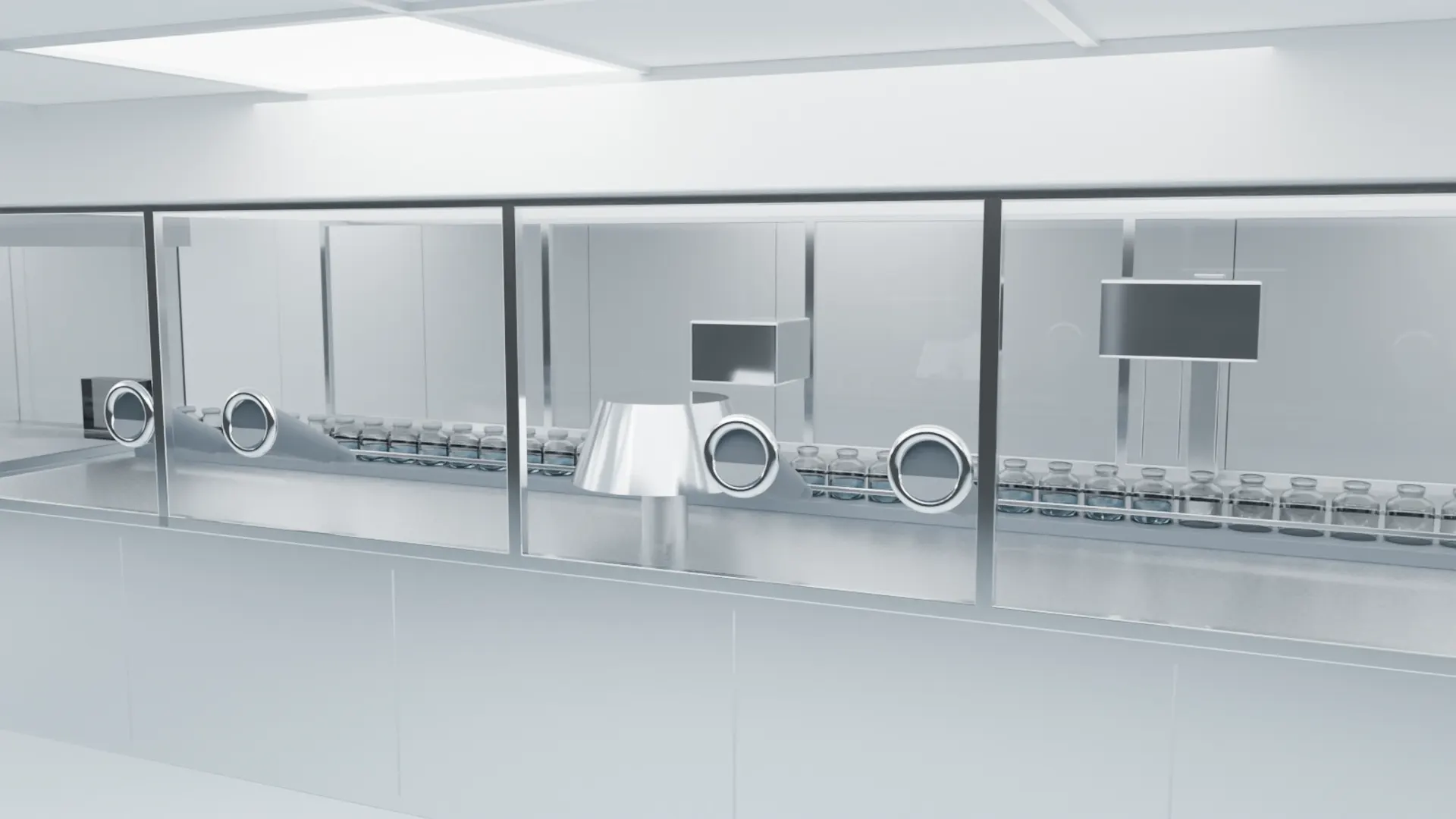
From the general corridor to the RABS gloves: at every door, the grade rises, the gowning changes and the pressure goes up.
07All the way to the finished product·After filling
EMA Annex 1
Contamination, controlled by design, at every barrier, through monitoring, all the way to inspection.Contamination,controlled
by design
at every barrier
through monitoring
all the way to inspection
The PBE Expert method
Thirteen levers, one strategy.
From the sterility assurance strategy all the way to inspection. At the end of the line, the detailed requirements: for each lever, what the team checks, its Annex 1 reference and its priority.
SAS, the sterility assurance strategy, covers the following twelve levers:
QRM: Quality risk management
CCS: Contamination control strategy
CCbD: Contamination control by design
Facility Design: design of the facilities
HVAC: HVAC and clean utilities
EMP: Environmental monitoring
CDbD: Cleaning and disinfection by design
RABS: RABS and isolators
PUPSIT: Filter integrity before use
APV/APS: Aseptic process simulation and validation
AFV: Airflow visualization
Inspection Readiness: Preparing for audits and inspections
RequirementThe inspector asks to seeThe PBE Expert team delivers
Contamination control strategyA site-specific, up-to-date CCS, linked to risks and monitoring resultsWriting or reviewing your CCS, lever by lever
Quality risk managementRisk assessments that justify the design and the limitsDocumented, reviewed risk assessments (FMEA)
Barrier technologiesQualified RABS or isolators, and controlled interventionsBarrier requirements (URS), design and qualification
Sterilizing filtrationFilter integrity tested before and after use, or the justificationAssessment and implementation of the test, or its justification
Aseptic process simulationWorst-case simulations: durations, shifts, interventionsDesign and follow-up of the simulations
Environmental monitoringJustified sampling points and limits, with trends trackedA risk-based monitoring plan
Self-assessment
Where does your site stand?
Fifteen questions, three minutes. Your profile takes shape with every answer, then your three priorities appear.
Question 1 of 15
The whole siteStrategy and CCS
Is your contamination control strategy (CCS) written, specific to your site and approved?
The whole siteStrategy and CCS
Do your risk assessments justify your design choices and your monitoring limits?
The whole siteStrategy and CCS
Is the CCS reviewed at defined intervals, taking in trends, deviations and changes?
Grades D to ARooms, grades and airflow
Are your rooms classified at rest and in operation, then requalified at the planned frequency?
Grades D to ARooms, grades and airflow
Is the pressure cascade between grades monitored continuously, with alarms?
Grades D to ARooms, grades and airflow
Do airflow visualization studies, filmed in operation, cover your interventions?
Grade ABarriers: RABS and isolators
Is your Grade A zone protected by a RABS or an isolator, or is its absence justified in writing?
Grade ABarriers: RABS and isolators
Is every intervention inside the barrier listed, assessed and limited, and is glove integrity checked?
Changing roomsPersonnel and gowning
Is everyone who enters Grade A or B qualified in gowning, then requalified at defined intervals?
Changing roomsPersonnel and gowning
Do your changing rooms separate the gowning stages, with interlocked doors and garments specific to each grade?
Filling lineAseptic process: filtration and simulation
Is the sterilizing filter integrity tested after sterilization and before use (PUPSIT), or is the absence of that test justified?
Filling lineAseptic process: filtration and simulation
Do your aseptic process simulations reproduce the worst case: duration, shifts, interventions?
All gradesMonitoring and utilities
Are the locations, frequencies and limits of your environmental monitoring justified by a risk assessment?
All gradesMonitoring and utilities
Do you trend your results (particles, microbiology, personnel), with alert levels and defined actions?
All gradesMonitoring and utilities
Are your product-contact utilities (water, clean steam, gases) qualified and monitored?
Your result
0%Self-reported level
PriorityTo strengthenUnder control
Your answers describe a well-prepared site. An independent review confirms the evidence before the inspector asks for it.
The foundations are in place. Some evidence is still missing to convince an inspector.
Several areas need a plan. Better to build it now than after an inspection finding.
Hands-on GMP FormAction™ courses, at your facility or in the classroom. PBE Expert is a CPMT-approved training organization: your costs are eligible expenses.
It is the annex to the European Union’s good manufacturing practices that governs the manufacture of sterile medicinal products. Its revision, published by the European Commission in August 2022, has been in force since August 25, 2023.
Who does it apply to?
Manufacturers of sterile products, such as injectables, that sell in Europe or whose authorities follow EU or PIC/S GMP. Its principles can also guide the manufacture of non-sterile products.
What is a contamination control strategy (CCS)?
A site-specific document that defines all critical control points and assesses the effectiveness of all the controls (design, procedural, technical and organizational) and the monitoring used to manage contamination risks.
Do we have to replace our existing cleanrooms?
Not necessarily. Annex 1 requires every choice to be justified by risk. A gap analysis shows what can be kept, adapted or replaced, and in what order.
Where do we start?
With a gap analysis: the PBE Expert team compares your facilities, processes and documents against the 13 levers, ranks the gaps by priority and gives you an action plan.
Can PBE Expert train our teams?
Yes. Our GMP FormAction™ courses are given at your facility or in the classroom. PBE Expert is a CPMT-approved training organization: your costs are eligible expenses.
SyringesAmpoules
Keep exploringAseptic fill and finishFrom vial washing to visual inspection: what happens in Grade A, the air, the barriers, the process simulation. Tour an aseptic filling suite in 3D with the PBE Expert team.Explore→